
Visitors
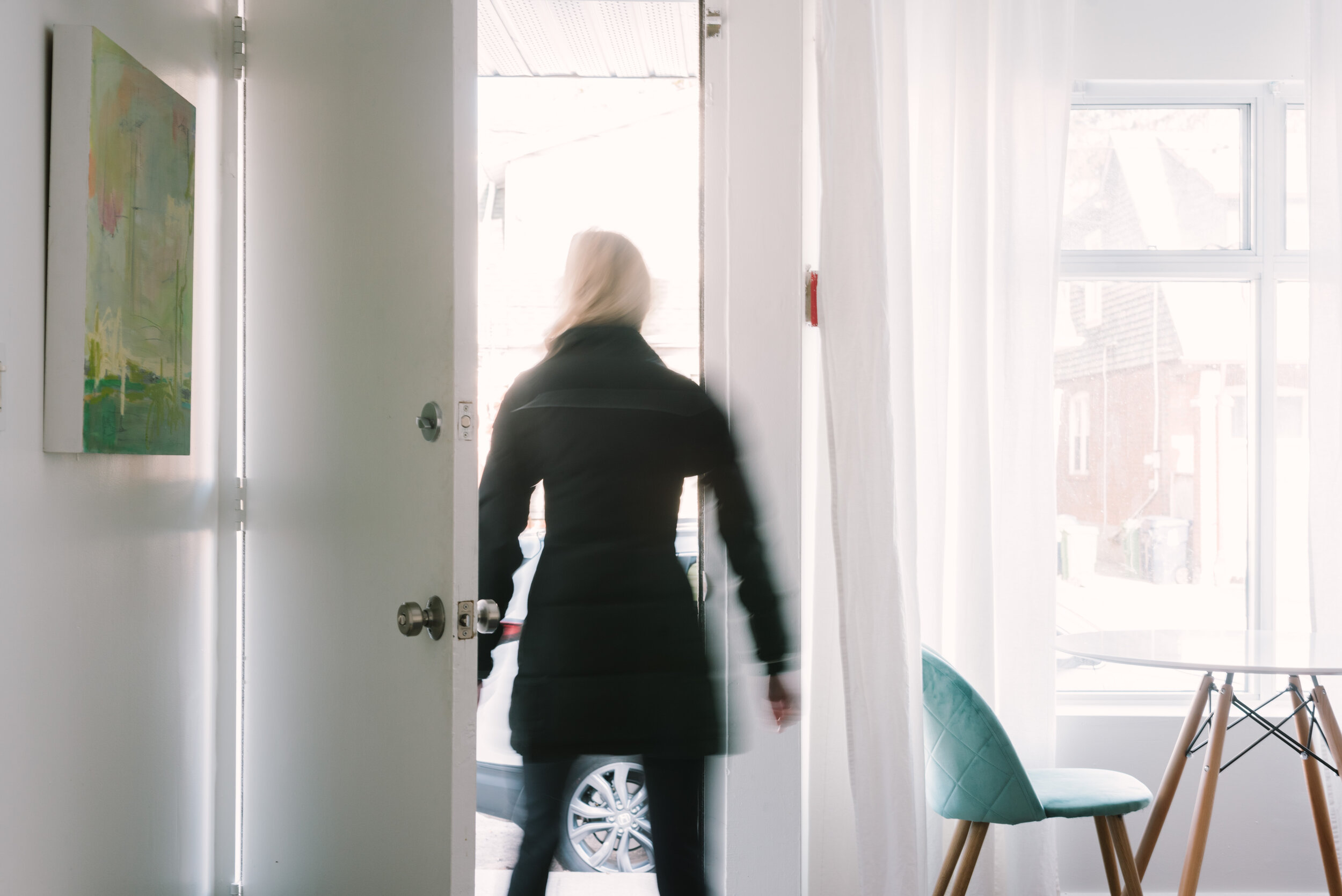
“Do you know where Nancy lives?”
It’s my neighbour, the eccentric one from the other side of the floor. What’s her name again? I’m standing in the doorway in my pyjamas. I stare at her—a stout woman with white hair, always pulled back, and a nervous laugh—willing my brain to conjure up her name from the crevices of my memory.
It’s the middle of a January snow storm, and the power in our condo building has gone out. The power grids in our part of town are constantly overloaded, struggling to keep pace with the unyielding stream of people flocking to the edges of the city.
The three of us—my neighbour, my husband, and I—are still standing there at the door, and I haven’t said anything. The woman is looking at me, and so is my husband, who now appears concerned at my inability to speak. Our 8-week-old son has just drifted off to sleep, and when the lights hanging over our dinner table flickered and the hum of our central heating system stopped, I felt my stores of rational thinking waver, too. Refusing to cooperate, my brain, like our power grid, protests, its finite neurons overloaded by the strain of new motherhood.
“Do you know where Nancy lives?” The woman asks again, urgency in her voice now. Something about her mother’s air mattress deflating. Need to move her to the bed. “Or maybe you can help?” Tina. The lights in my brain flicker back online. Tina who lives with her aging mother; whose small dog barks in increasing volume as it waits for the elevator; whose thin-lipped smile I know from our conversations in the hallway as we carry bags of iced tea and produce. Tina is my neighbour.
Though her name is now clear in my mind, everything else still feels like a fog. I mumble, point across the hall to where Nancy lives, and shut the door.
—
I can hear her on the phone as I wait at the door, her voice fading in and out as she paces her apartment: “I don’t know why she would ask that, I called her last week to explain . . . yes, Harv, I know—” The door unlocks and her eyes look me up and down as the phone balances on her shoulder. “Hi, yes?”
My words tumble out as quickly as my face warms. “I’m embarrassed at our last interaction,” I begin. Her eyes dart upward like a question; she doesn’t recall. “The other night, during the power outage . . . I should have helped. I’m sorry.” I mean it, but I can’t bring myself to elaborate on the sleepless nights, the reprise of first-year-of-marriage arguments with my husband, or hour-long battles trying to get our infant to sleep. I am exhausted, and I suspect she knows it even without the lengthy justification.
“Oh that is so nice of you to come over! Don’t worry about it, hon, we handled it,” she says, waving me off with a wink.
—
The first time Tina meets Elliot, the annual thaw has begun. We share an elevator ride after an early spring walk, during which I optimistically wear sneakers while the baby remains bundled in a borrowed snowsuit.
Wide-eyed and awake, our son is no longer a fragile newborn: giggles, gummy grins, and semblances of routine emerge as the season changes. I’m not sure if my hope for spring has ushered, or follows, my delight as our child becomes deliberative, alert, human. Where once I measured the days in 24-hour cycles, I now count minutes of wake windows, or even hours, stolen to myself again. The moments of frozen indecision and anxiety are fewer and far between, trust replacing the disorientation I once felt at holding a tiny stranger in my arms.
Before we part ways outside the closing elevator doors on the 17th floor, Tina lingers. “My mother passed this week,” she tells me, emotion revealing itself in her voice. “It was a long time coming.”
She pauses, maybe wondering if she means what she will say next. “She’s in a better place now,” she offers at last, a sliver of relief punctuating her exhaustion. We stand there for a few moments in the hallway, as we did that night in January. Suspended.
The moment feels sacred, our silence a mutual admission of our mortality—tiny and infantile—at the hand of time. We’re interrupted by Elliot cooing, staring at Tina from his stroller and kicking his feet impatiently. My baby, whose days and nights are organized only by his bodily needs, refuses to let time stand still, for even a moment like this.
—
Elliot is six months old, and I find myself in daily wonder at the boy he is becoming. Imagine, I write in my journal, from the barely awake bundle in the hospital to a human being with preferences and a personality! Around new people, I notice in Elliot my husband’s unobtrusive curiosity; when contending with slippery mango in his hand, my strong-willed stubbornness. Even more magical, of course, are the qualities I observe in him that I can’t place in either of us.
The sun is glowing and warm when I run into Tina one summer weekend. We squint as we approach each other on the sidewalk, her keys jangling as she waves me over, a wide, pink-lipsticked smile on her face. Her hair is loose and reaches past her shoulders, skimming the top of her red tank top. I’m surprised. I haven’t seen her with her hair down enough to notice its length or its prettiness.
It isn’t her words that convince me she is well; it’s the ease at which she tells me about her early summer, the way her whole face crinkles when she laughs, the wildflowers in her hand from the neighbourhood farmer’s market. She is as much the same neighbour who appeared at my door during that winter snowstorm as she is not.
Walking back to our building, I realize the change of seasons has transformed her, and I imagine I look different, too. The cracks in my hands and sway in my back betray the body I had six months ago, when I could only imagine my son dancing inside my belly as we played Charlie Haden covers before falling asleep at night. Now, taking in the world for the first time, he belly-laughs in my arms as we dance together in the kitchen, the cold and crippling winter forgotten by the both of us.
On our 17th floor, death has come to visit, and, mysteriously, so has new life.
Text: Season Kam