
Stories for Isolation from "The Expanse"
It’s March, and I’m sitting at my desk in an empty room atop an empty building, next to a window overlooking an almost-empty Bloor Street. I’m alone in my bubble. Everyone in Toronto is holding a collective breath, lest we cough on one another and spread the novel coronavirus. We’re all newly fluent in pandemic lexicon; poised above the plunge of a rollercoaster ride nobody wants, we hope that “social distancing” and “self-isolation” can “flatten the curve.” This new language betrays the way that the world has changed, seemingly overnight, contracting around us under the pressure of an impersonal force we are struggling to understand. The one certain thing is uncertainty—no one knows what happens next.
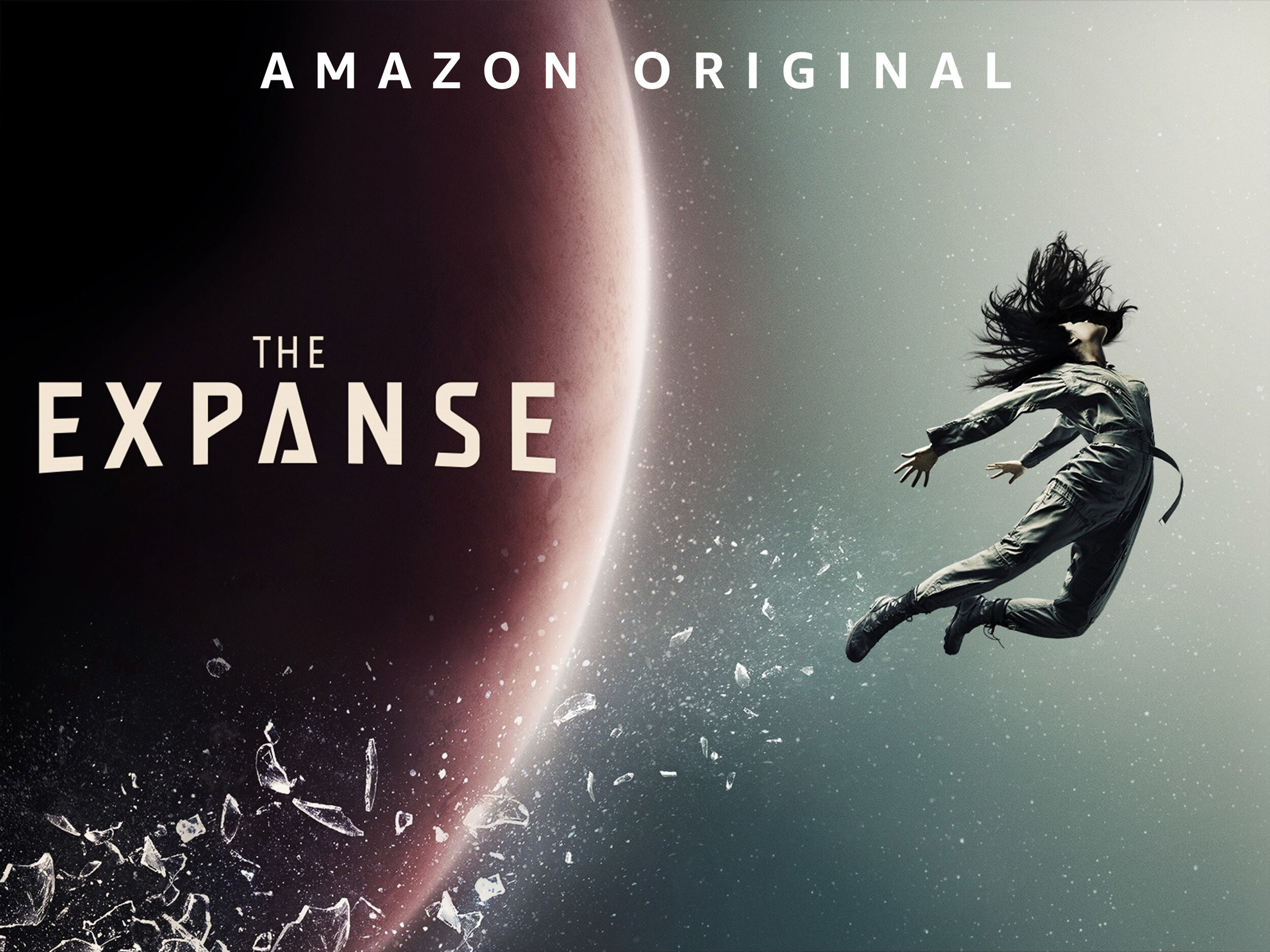
With so many of us confined to quarters, streaming platforms have been enjoying a surge in activity; for my part, I’ve been re-watching “The Expanse,” which has become startlingly relevant in these disconcerting days. (Find all four seasons online on Amazon Prime. Light spoilers ahead for season 1). There’s a banal parallel between life in the confines of a small spaceship and life in the confines of a Toronto apartment, and one character’s sheer joy at discovering a stash of fresh coffee beans is all too relatable! The spark of sympathetic pleasure I felt in that moment captures a broader identification I have with the show’s characters, whose world is turned upside down and who must learn to live (and survive) together.
Science fiction as a genre can seem distant because it’s engaged in speculation about the future, and it runs the risk of mis-predicting how human life will change. The goal of the best kind of sci-fi is not prediction, though, but plausibility—to imagine what could happen. Its true subject is the one constant of our history, humanity itself.
This quality means that good science fiction like “The Expanse” becomes especially relevant when we’re plunged into a period of rapid change and forced to rethink our collectivities. The COVID-19 pandemic not only threatens our bodies but, because it travels in asymptomatic carriers, freights any embodied act of human connection with risk. Meetings, hugs, and handshakes have become dangerous. We encounter other human beings as threats; not neighbours, but potential double agents, friends transformed from people into vehicles for the virus. The division of human beings against each other is as old as sin, but a pandemic season adds a uniquely visceral emphasis to the fear of others. Our daily temptation is to contract our love and care for each other along with the contracting physical boundaries of our lives, managing fear and uncertainty by focusing the story on ourselves. Exhausted, we are being challenged to fight the virus in our bubbles without forgetting that every other bubble matters, too.
Survival: The Problem of the One and the Many
Based on an acclaimed series of novels by James S. A. Corey, “The Expanse” begins as the story of four crew members who survive the loss of their spaceship and find themselves in the middle of a political and social conspiracy with consequences for the whole human race. Set in the 23rd century, an uneasy interplanetary peace exists among an aging, overpopulated Earth, a colonized, militaristic Mars, and the impoverished mining stations of the asteroids beyond them (“the Belt”). This is classic science-fiction territory, and the four crew members—Holden, Alex, Naomi, and Amos—must learn to trust each other as they make their way through the dangerous stations and frontier towns of the Belt, searching to uncover the frightening truth behind a series of catastrophes that began with the destruction of their spaceship.
The show shines in its interweaving of this central plot with a number of other narratives, which expand the show’s scope to encompass the whole solar system. Characters like the Belter detective Josephus Miller, UN politician Chrisjen Avasarala, Tycho shipyard boss Fred Johnson, and many others have individual quirks and nuanced motivations which imply a depth of story beyond what the audience has time to see. Well-designed sets and linguistic cues help navigate scene transitions by making diverse locations unique and recognizable. “The Expanse” walks a tricky narrative tightrope between spreading the audience’s attention too thin or else contracting it down to the walls of a single spaceship. The result is a genuinely brilliant show in keeping with the best of science fiction, which tells a story that is both politically and psychologically compelling.
I find “The Expanse” intriguing for its plausible vision of the future and exciting for its interstellar battles and political maneuverings; I find it meaningful because its very narrative form registers the conviction that every character has their own story within the larger one. There are no “minor” or “supporting” cast members when it comes to humanity, and the show admires its compassionate characters and rewards the audience with deep storytelling when we share their interest in others. Despite how difficult it can be to live through black swan events, the bare fact of continued life is not enough to give it meaning. In an intense exchange partway through the first season, the hard-bitten mechanic Amos tells a saboteur he’s just caught not to take his imminent demise personally:
We’re just caught up in the churn, is all . . . When the rules of the game change.
- What game?
The only game. Survival. When the jungle tears itself down, and builds itself into somethin’ new. Guys like you and me, we end up dead. It doesn’t really mean anything. Or we happen to live through it, and well, that doesn’t mean anything either.
“The Expanse” fandom on social media was quick to identify with being “caught up in the churn” as the wave of COVID-19 crashed over us, a massive, impersonal force that changed the rules of the world overnight. One response to this kind of change is a brutally Darwinian and nihilistic pursuit of pure survival, every man for himself—and several of the series’ villains try to divide the crew by appealing to animal self-interest in Amos. What such characters misunderstand is that although Amos is a skilled survivor (without implicating myself too deeply in spoilers here), he finds purpose for survival in protecting good people around him. Amos’ devotion to his fellow crew members does on an individual level what the empathetic tech Naomi fights to do on a collective level: build communities that value the lives of others as much as their own. “The Expanse” shows how in the cold vacuum of space, fear and selfishness drive people to hoard life-giving commodities like air and water in bare attempts to survive. However, the show insists that we have an ethical responsibility not to retreat from each other, because survival only has meaning if it’s shared.
Every Body Matters
Science fiction often examines humanity’s interconnectedness by juxtaposing us against an alien “hivemind”—Orson Scott Card’s Ender’s Game is a perfect example—stressing the effort it takes human beings to cooperate but celebrating the inventiveness of our free wills. It’s an image that tends towards the cerebral and abstract. The battles that Ender fights are theoretical, his orders carried out by nameless, faceless soldiers who fight and die light-years away. While “The Expanse” deals with similar challenges to human cooperation and creativity, here they appear in profoundly embodied ways. The differences between “Earthers” and “Belters,” for example, can be seen at a glance in the elongated bones of people who’ve grown up in the reduced gravity of space. Bodies can divide people just as surely as culture and politics do. Appropriately, the first existential threat to humanity in “The Expanse” is an alien virus, which invades and distorts human bodies. It’s personal. Humanity reacts with quarantine protocols and vaccine research, but ultimately it takes the cooperation of all the warring factions of humanity to contain the virus. The four central protagonists become a microcosm of the way that different people—different bodies—can form a unit whose strength comes from the contrasting, complementary abilities of its Earther, Martian, and Belter members.
My faith tradition has a beautiful image of how believers are united as the hands and feet of Christ. The metaphor of the body is commonly used by the Apostle Paul in his letters, and it’s a powerful metaphor for a pandemic moment. The only way to survive is to treat each other as parts of the same body. When we do, our actions become expressions of divine care, reminders of a ultimate relief to come. That’s a tall order but living through a pandemic tests our convictions by barraging us with decision points: when and how often to leave our houses, when and how long to wash our hands, when and how to take on risks for vulnerable members of the population. It’s not enough just to know that others matter—we need stories that connect our bodies and our ethics. “The Expanse” is one of those stories.
In the pilot episode, the crew of an unwieldy ice-hauling spaceship become grudging Good Samaritans when they answer a distress call. The decision falls on the ship’s first officer as he sits during a quiet watch, listening on repeat to the static-blurred voice pleading for help, one human being reaching out to another. The crew must make a quick deceleration to intervene, and as they “flip and burn” (reorienting the ship’s massive engines against their existing momentum), the ship creaks and groans while each of their bodies is subjected to the crushing power of the engines’ opposite thrust. In the vast, unforgiving physics of space every ethical choice carries an extra gravity, and the cost of the crew’s choice is written in the pain on their faces. The intersection of physics and ethics that drives the tension of that scene is an area where “The Expanse” excels, making the setting of space immediate and consequential for the narrative. It also establishes the way that, throughout the show, caring for human life strains our shared bodies to their limits.
The Purchase of Hope
Our tightly-woven, embodied interconnectedness is being exploited as a vulnerability by the coronavirus, and the only way to see each other as neighbours instead of others competing for the same resources is to find hope that rises above our fear. En route to the asteroid station of Eros, Detective Miller meets a Mormon missionary about to leave on an uncertain colony mission, believing that God will provide. “Doesn’t that scare the shit outta you?” scoffs Miller, to which the Mormon replies, “Yeah, of course it does! But I put myself in the hands of God. True faith is a risk.”
Unlike in some other science-fiction franchises, religion held in good faith is treated respectfully in “The Expanse,” because the series creators recognize that human beings have an innate need to believe in something—a source of good or direction of some kind beyond themselves. Each of the show’s protagonists finds a different object of faith, but what sets the heroes and villains of the show apart is not just what they believe in, but whether they set aside the individual worth of other human beings in their pursuit of a better future. However grimy and flawed its true protagonists are, the power of faith is in the hope it produces, and its worth can be measured by the sacrifices that purchase it.
At this moment in time, we ourselves may feel “caught up in the churn.” Hope can mean accepting risk to care for others, or else bearing the psychological burdens of self-isolation. As I write we’re learning how technology can help build resilience against both pressures. For me, this has meant starting a virtual tabletop game with my siblings, so we’re gradually figuring out how to use screen-sharing and online tools to create an imaginative world together. The pandemic is testing our collective empathy and perseverance; in a modern quarantine, this means learning to create conversational space for each other and reconnecting dropped calls as many times as necessary! Instead of writing long-form letters a friend and I have been exchanging brief video greetings with each other and our kids, while another of my friends has redirected his 3D-printing hobby to produce components of personal protective equipment for a local hospital. All of this takes time: time to learn, time to connect, and time to do.
Now that the reality has settled in, our communities are shrunk to nuclei under the weight of the COVID-19 pandemic, precisely because of the responsibility we carry for each other, friends and strangers alike. Our view is contracted, so to speak, to the walls of the spaceship. Nevertheless, the call to live selflessly has not and will not change, nor will the reward of living in hope. Because, as “The Expanse” compellingly reminds us, survival worth having is our collective task.
Text: Joel Faber