
A Physicist Dwells on Time
Angels, help us to adore him
Ye behold him face to face
Sun and moon, bow down before him
Dwellers all in time and space
Alleluia, alleluia!
Praise with us the God of grace.
From “Praise, My Soul, the King of Heaven” by Henry Lyte
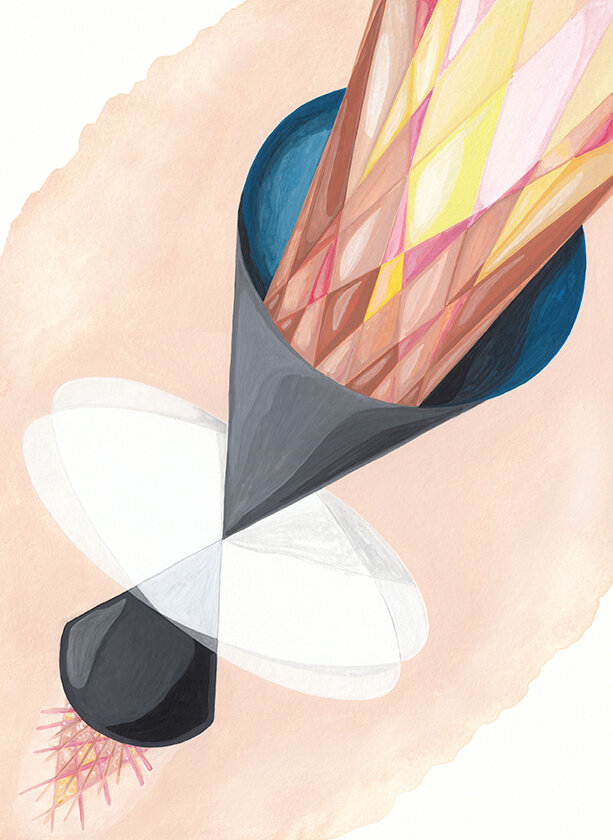
Although we often take it for granted, the concept of time can be difficult to fully comprehend, whether the context is physics or theology. In pondering Albert Einstein's theory of relativity, where time can slow down and space can bend, students of physics might well agree with the rhetorical question and answer of Augustine's fourth century Confessions [Book XI]: "What then is time? If no one ask of me, I know: if I wish to explain it to one who asks, I know not." Augustine's musings focus primarily on the awesome paradox of an eternal God interacting with mortal humans; but his conceptual struggle would be equally at home in a course on modern physics.
Augustine's question—"What then is time?''—is probably of less immediate concern to most of us than it was to either Augustine himself or to Einstein some 15 centuries later. Nonetheless, it's a question worth a little pondering. After all, the way we understand time can have a considerable impact on what we do with it.
That last thought—the idea of "doing something'' with time—encapsulates the way most of us think about time in everyday life. For most of us, time is primarily a commodity, a consumable, and one that's usually in short supply. Everybody needs more time: more time to work; more time to play; more time for family or friends or just for ourselves. Without even noticing, we constantly make sacrifices—skipping breakfast, avoiding that talkative coworker, driving a little too fast—all to conserve this most valuable of resources.
To the physicist, though, time has another meaning. As the "fourth dimension'' of our universe, time is much more like a place than a resource. For most of us, the idea of a fourth dimension sounds exotic or even a bit surreal. Einstein himself acknowledged in Relativity that talk of "four-dimensional things'' tends to evoke a "mysterious shuddering'' in non-mathematicians, "a feeling not unlike that awakened by thoughts of the occult.” The reality, however, isn't quite so bad. Indeed, according to Einstein, no statement could be simpler than to acknowledge that we live in a four-dimensional universe, the "space-time continuum.'' Every event of our lives--and of the world around us--is characterized (to the empirical physicist) by four numbers: three spatial coordinates and a time. An invitation to a birthday party, for example, specifies not just where the party will happen (the first three dimensions) but also when (the fourth dimension). Without both pieces of information, guests have little hope of actually arriving for the event. At its most basic level, the physical concept of "space-time'' is just a way of treating space and time on the same footing, so that the "where'' and the "when'' become, in some sense, equivalent. To the physicist, then, time is not simply a resource but, like the three-dimensional space around us, a place of existence.
What I find striking about this perspective is its similarity to the view adopted by the clergyman Henry Lyte in his 1843 hymn, "Praise, My Soul, the King of Heaven.'' More than half a century before Einstein's four-dimensional theory, Lyte calls for praise to the Creator from his entire creation: from the sun, moon, and "dwellers all in time and space.'' For Lyte, as for Einstein, space and time are not a resource for us to exploit, but a place for us to dwell.
Although this view may at first appear contrived or quaint, it turns out to have profound implications both for the physicist and for the Christian. Einstein's view of space and time as equivalent quantities, together with his foundational hypothesis that the speed of light is an absolute constant, revolutionized physics near the turn of the 20th century. Much of modern physics is almost unthinkable without it.
But the idea of time as a dwelling place can be no less powerful in the Christian life. In the mad rush of modern society, it's easy to get impatient with how much we're accomplishing with the limited time available. Whether we find fault with ourselves, our friends and family, the government, or God himself, it's easy to feel that somebody is wasting our precious time. And why does that bother us so much? Because whether young or old, whether we admit it or not, we feel the truth that our time on earth is running out. On the inside, we're afraid: If we don't get things done soon, we may never get them done at all.
Given our limited view of space-time, it's not surprising that we feel this way. At best, we have a one-sided view of our four-dimensional universe: we can only see the past, much as though we're stuck trying to view a great work of art but can catch only glimpses here and there of the left-hand side. Given this state of affairs, it's perhaps only natural that we feel anxious for the future.
In the face of that anxiety, it's good to remember that the God we serve is subject to no such limitations and that, for Him, time is never in short supply. As the apostle Paul writes in Colossians 1:17, the Christ we serve is "before all things, and in Him all things hold together.'' Given our own limited view of time, it's good to know that we serve a God who exists outside of it.
But the good news is better than that. Not only is God's view of the space-time painting better than ours, God himself is the artist. Most importantly, our own place in the universe—both in space and time—has been laid out for us (quite literally!) ahead of time. As the apostle Paul writes in Ephesians, we ourselves are "God's handiwork, created in Christ Jesus to do good works which God prepared in advance for us to do.'' In other words, it is God himself who allotted for us the space and time in which we dwell, and it is God himself who graciously offers us a role in his grand design for creation. And all those good things we want to get done? If they're really good, God will make sure they get done at exactly the right place and time.
So the next time you're feeling rushed, pause a moment to remember that we're all just travellers here in space-time. Like the physical space around us, time is not so much a commodity for us to hold onto but a place in which we exist. And like the sun and moon in Lyte’s poem, our job here is simply to dwell humbly in the space-time allotted to us, praising God for his magnificent work and rejoicing in the share he offers us in his work and in his kingdom.
Text: Mike Reppert
Artwork: Becky Chai