
A City in Transit
TORONTO’S TRANSPORTATION HISTORY SHOWS A CITY BALANCING THE PRESERVATION OF THE PAST WITH THE RELENTLESS MARCH OF CHANGE.
Cities are built to weather the years. In stone and granite and brick, they strive for permanence. Yet global cities like Toronto are also faced with the ongoing challenges of keeping time: through its institutions, and also in a pedestrian way, its transportation. A study of Toronto’s transportation history—particularly Union Station and the Spadina Expressway project—offers a perspective on a city in transit. We see a reflection of the way the city keeps time, in what changes drastically and what stays the same.
Union Station is a landmark that preserves the city’s history while navigating changes from horses to subway lines. The Spadina Expressway, a project whose effects are most clearly seen in relief, shows a city grappling with the often warring needs of transportation and the relentless demands of technological progress. Though they are only two small parts of Toronto’s history, through them we see how the problems of the past resemble the new ones we encounter today. We witness the effect of imperfect solutions and place ourselves within the context of our city’s story. Marking time through transportation allows us to honour the past while finding a way to navigate the future.
Union Station: A Gateway to the City
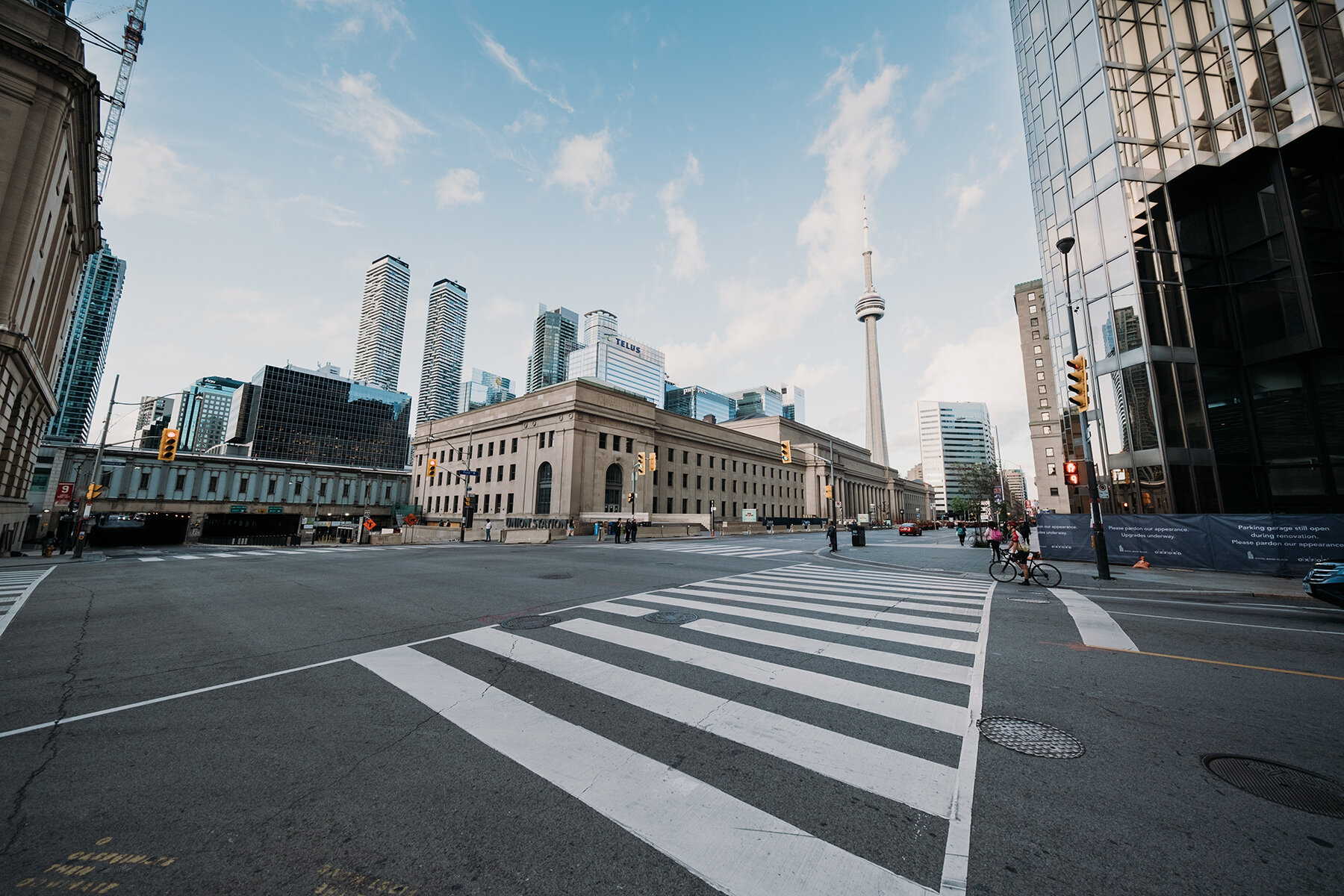
On the east side of Union Station, a column houses a bronze plaque which states, “At this place on May 16, 1853, the first train in Ontario hauled by a steam locomotive started and ran to Aurora.” From the mid-1850s to the early 20th century, the ground near where Union Station stands today was patterned with tracks from the Grand Trunk Railway, Great Western Railway, and the Ontario, Simcoe and Huron Railway (later renamed the Northern Railway of Canada).
By 1913, the need for a new station was clear. Overcrowding and inefficiencies led a Globe reporter to write a scathing review titled “That Dreadful Union Station” in which he suggested that stalling the Canadian Pacific Rail- way President’s train and forcing him to walk through the yard might push the plans forward.
Plans for the station were drawn up by the Toronto Terminals Railway Company, and the station’s architects were Ross and Macdonald and H.G. Jones of Montreal and John M. Lyle of Toronto. The plans were approved in April 1914, and general contractor P. Lyall and Son Construction Company began construction in September. By 1920, the station was mostly complete but due to politics, the concourse wasn’t built for another several years. On August 6, 1927, the new Union Station was officially opened in a 13-minute ceremony (coincidentally, one minute for each year of construction) with Edward, Prince of Wales. At 12:01 a.m. on Thursday, August 11, 1927, the station was finally opened to the public.
By the mid-1940s, Union Station had grown to be a destination in its own right, with a gallery of mural art and daily organ recitals. During the war years, trains carried soldiers off to war and for the next two decades, it saw traffic from Canada’s immigration boom. Today, over 300,000 people make their way through the station each day.
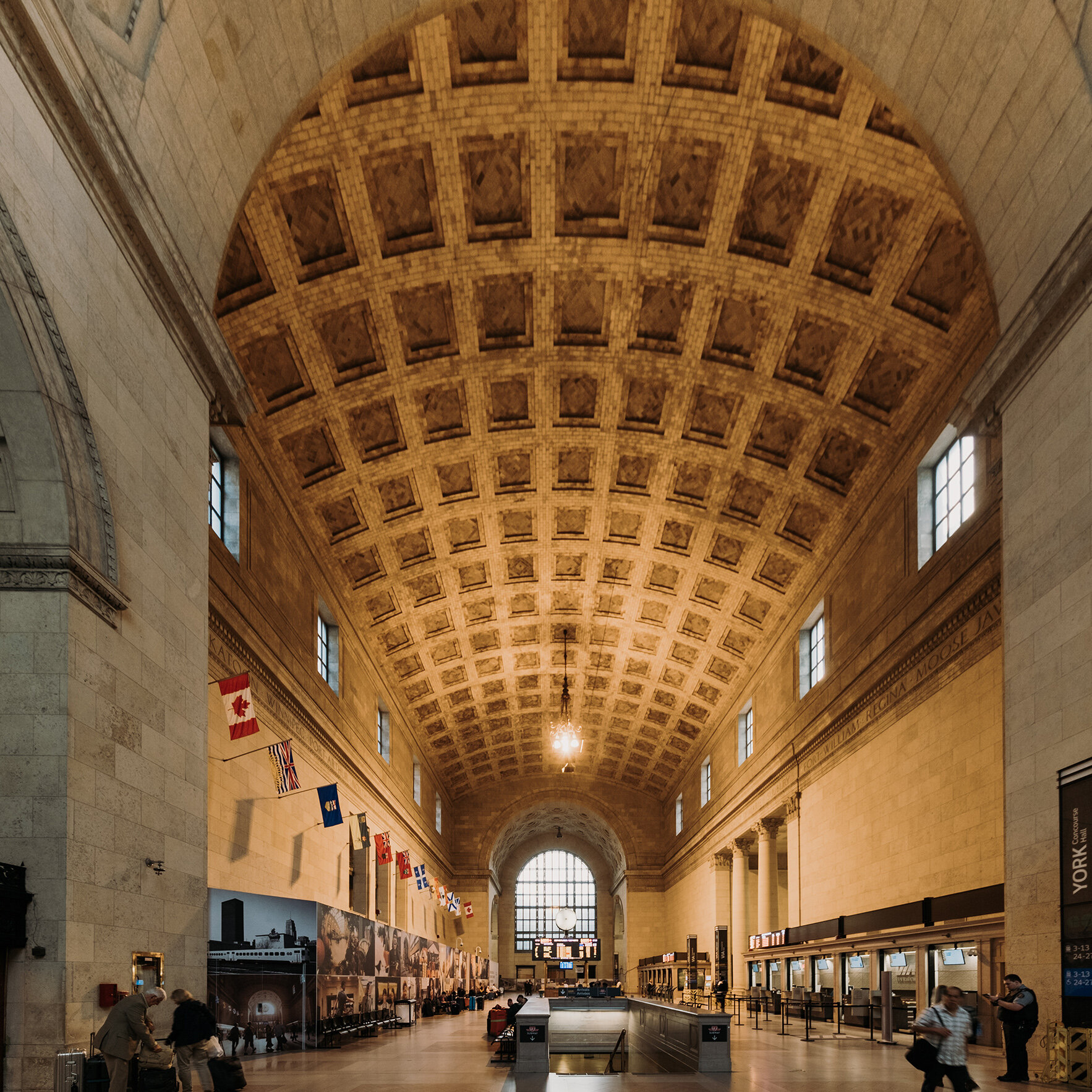
In its very construction, Union Station is a mark of permanence. Constructed of Missouri Zumbro stone walls with floors and stairways layered in Tennessee marble and an arched ceil- ing faced with vitrified Guastavino tile, the station was built to last.
But this architectural landmark has also been witness to a changing city. In an essay on Union Station, Pierre Berton, an acclaimed Canadian author, writes: “A railway station, especially a large one, is something like a home: it acquires a certain aura after it has been used ... a sense of presence remains—a feeling, an echo perhaps, that tells you lives were lived here, tragedies enacted, triumphs rewarded, loves consummated, and that this building knew the cycle of birth, life, and death, of hope and despair, of sadness and joy.”
For many today, Union Station is a fixture of Toronto’s waterfront. It’s a place to pass through with the com- muter crowds or a landmark that seems to be perpetually under construction. But in many ways, and for many years, Union Station has served as a gateway to the city of Toronto—a doorway to new experiences and opportunities and for some, a new life. As Pierre Berton remarks, “There was a time when almost everybody who arrived in the city and almost everybody who left it passed through those familiar columns of Bedford limestone.”
In Toronto Remembered, William Kilbourn reflects: “The Union Station, after all, is more than a piece of architecture; it is part of our history as a transcontinental nation.” It’s a representation of the relentless marching of change and a doorway that links the many people who have found respite within Toronto’s borders.
THE SPADINA EXPRESSWAY: GHOSTS OF CHANGE
Early in the morning on Earth Day in 1970, a group of Torontonians— including an Anglican worker-priest, a United Church reverend, an alderman, a columnist, and a Toronto Star photographer—gathered on a clearing near Spadina Ave. They dug holes for small trees they had brought along and planted them. Then Father Heap (the Anglican priest) blessed the place. But the tree planting wasn’t simply an Earth Day ritual, and the gathering was more than an early morning meeting of friends. It was an act of peaceful protest against one of Toronto’s most contentious transportation projects, the Spadina Expressway.
It all began in the 1940s with a proposal suggesting the creation of a new arterial route by widening Spadina from Fleet St. to St. Clair Ave. Over the next decade, the plan changed and expanded but mostly lingered on the city’s agenda. In 1954, the same year the Municipality of Metro Toronto was formed, they began actively planning the Spadina extension which, at that point, had evolved into a controlled-access expressway. The Spadina Expressway was part of an extensive expressway plan that surrounded the city and Metro Toronto with the Gardiner, tying the routes together south of the city. The goal of the plan was to ease traffic congestion due to the increasing number of commuters travelling into the city from surrounding suburbs. By the end of the ’50s, the province had approved a clover-leaf intersection at Spadina and 401 on the contingency that Metro would guarantee construction of the Spadina Expressway. On March 6, 1962, Metro voted and earmarked $73,689,000 for construction of the Spadina Expressway to Bloor.
By the end of 1966, the first portion of the Expressway—from Wilson Heights to Lawrence Avenue—was opened. The section down to Eglinton was projected to be complete by 1971. But the most contentious portion so far, a section that would cut through the Cedarvale and Nordheimer ravines, had yet to be approved. Although a promise to tunnel below the parks calmed some of the tensions, the opposition had already begun to grow, and neighbourhoods south of St. Clair started to organize in protest.
The south portion of the Expressway was riddled with problems: cancellation of the crosstown portion of the expressway plan meant there was no clear explanation for where the estimated 5,000 cars per hour that would be dumped into the downtown core would go; construction would do extensive damage to vibrant neighbourhoods like the Annex; hundreds of houses would need to be demolished in order to create space for the Expressway.
In October 1969, the Stop Spadina Save Our City Coordinating Committee (SSSOCCC) was formed. Chaired by University of Toronto professor Alan Powell, the group brought together people from all backgrounds including students, academics, ratepayer groups, and business people.
By this point, the initial budget for the project was running low, and Metro needed to go back to the Ontario Municipal Board for permission to incur additional debt. After a 16-day hearing, the board approved the spending. Disappointed at the municipal level, protesters turned their attention to the provincial government. Although the provincial government had originally pledged to stay out of the debate, 1971 brought a new premier, Bill Davis. On June 3 of that year, Davis informed the legislature that the cabinet had completed its review and the Expressway was dead. In the often-quoted words of Davis, “If we are building a transportation system to serve the automobile, the Spadina Expressway would be a good place to start. But if we are building a transportation system to serve people, the Spadina Expressway is a good place to stop.”
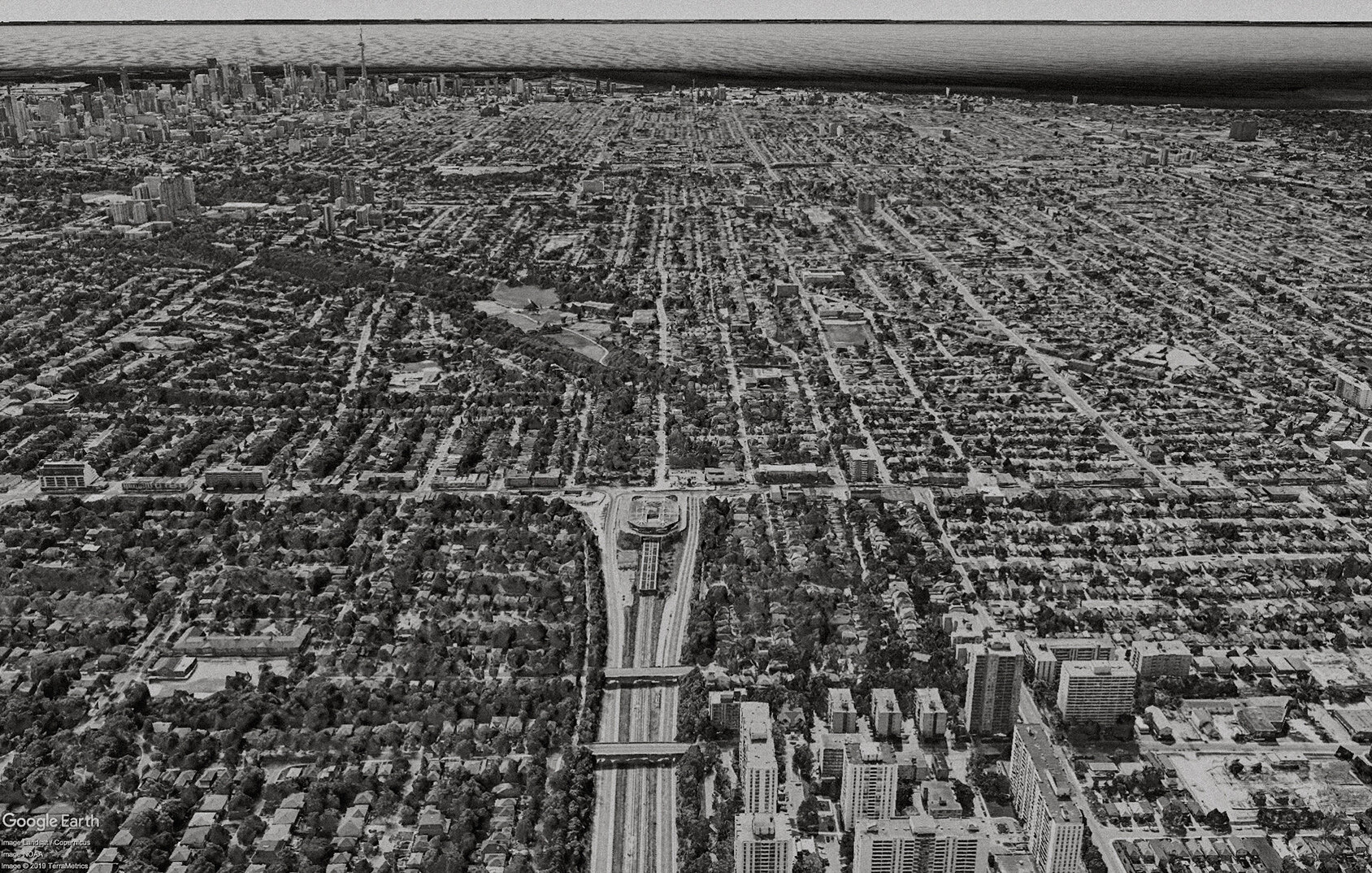
With Davis’s announcement, the Spadina Expressway project came to a halt, leaving physical ghosts to linger—especially if you know where to look. The northern portion of the original expressway (renamed Allen Road) carries a flow of traffic from the 401 to Eglinton, where it abruptly terminates. The Spadina-facing facade of the University of Toronto’s New College is nearly windowless (why add windows when the view is destined to be an expressway?) and in front of the Toronto Archives building north of Dupont is an empty lawn. These eccentricities pro- vide nudges to remember that even though change is inevitable, it has consequences—large and small, intended or unintended.
As the Toronto Star commented in June 1971: “The Spadina issue drove a wedge between suburbanites and downtown residents as had no other in recent years ... On the plus side, and regardless of the outcome, it made people all over Metro examine what they wanted out of their city and made them face up to the price of progress.”
More than simply echoes of the past, these two transit projects portray Toronto’s trajectory in an ever-chang- ing world. How would Toronto’s residents steer the city into the future as the needs of city-dwellers evolved and railways gave way to rapid transit and subway lines?
Premier Davis’s closing statement on the Expressway leads to questions that continue to be relevant today. Should the city be constructed for people or for cars? How do we balance preserving a city’s history while also meeting the demands of modernity? The answers aren’t simple and even though the Expressway’s southward advance was halted, as the Star reflected, “The outcome of yesterday’s decision—who really won—won’t be known for years.”
In many ways the battle between the needs of cars, neighbourhoods, and people is still being fought today. Our city continues to grapple with an exploding population and overcrowded public transit options. As residents and business owners along the Eglinton Crosstown Light Rail Transit Project understand, addressing the problems of a growing, changing city requires, not only billions of dollars of investment, but nearly a decade’s worth of patience. Improvements are not made cheaply, nor are they made quickly.
Exploring the history of Union Station and the Expressway project is more than an act of historical curiosity. Toronto’s transit story shows a city that must continue to reimagine itself, a city engaged in the bargaining required for keeping up with time. Our historical understanding shapes our present consciousness and provides guidance for building our future city.
Text: Katrina Togeretz
Photography: Wasim Hossain